I've been using the Bullet Journal for a month or two now. I like the system.
I'm using a graph lined composition book from Staples for my actual journal. I use the note and task boxes. If I complete a task, I check the box. If I move the task to the next day or later, I put a right pointing arrow in the box. I don't really use the event marks. A note mark is just as easy.
I've been sick for a couple of weeks, or this update would have been published sooner.
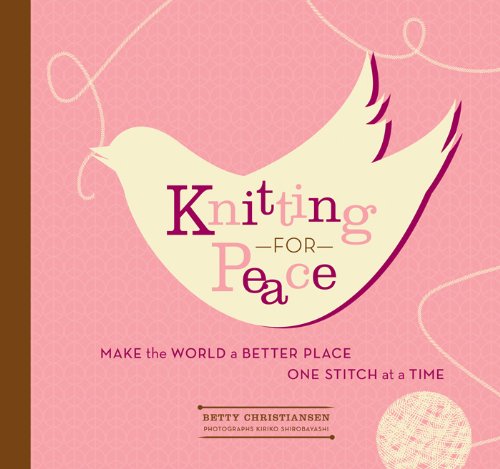
In her book, Knitting for Peace, Betty Christiansen shares charities and history of charitible knitting through the centuries. There are sections about specific kinds of knitting for peace.
I especially liked the section on knitting for children and the highlight of Afghans for Afghans. There's also patterns for various items needed by people and animals the world over. I liked the sweater patterns for the children and the hats for the children.
A Maine company, Peace Fleece, was highlighted as they produce yarn that is a combination of fibers from Russia and the United States. They also shared their basic socks pattern. I made these socks a while ago out of Peace Fleece wool and unfortunately found out the result of using machines to wash and dry 100% wool. My young niece received thick boot socks/slippers that Christmas. :)
I received my copy of this book from NetGalley in exchange for my honest review. I always provide a valid review of the book in question. For the eversion of this book, which is what I was reviewing, I gave it 5 stars.
The above video is a handy introduction to the BulletJournal.com system of organizing your days and tasks.
Basically there are three types of data to enter, tasks, events and notes. Tasks are signified by an open check box. As a task is completed, the check box gets checked. Events are signified by an open circle. Events are appointments and dates that you want to remember. Events can include food journals, chronic illness tracking and other such things. Notes are signified by closed dots/circles. Notes are things that you want to remember, but are not tasks or events. These three types of data are fairly easy to keep track of.
What happens if plans change? Then you place a right arrow through the open box or circle indicating that the task or event has been postponed. If a task or event becomes obsolete, just cross it off the list for that day. There you have it for those unexpected life happenings.
How do I know if something is important or I want to find out more about it? For important things, I use an exclamation point in the margin next to the signifier for that data point. For things I want to investigate, I sketch an eye in the margin to show that I want to look up info about "x". But, how do I know what the various symbols mean?
I have an index page in the front of my journal. There is also a key/legend page opposite the beginning of the index. The legend page is where I have all the signifiers and their associated meanings. The index page is a listing of what kind of data is on pages such and such. I have a few blank pages after the first index page before the beginning of my first calendar pages.
On a fresh spread, I topic each page with the name of the month and year for the current month. I list the dates down the margin of the left page. In the margin next to each date, I put the day of the week abbreviations used at my first college. U=Sunday, M=Monday, T=Tuesday, W=Wednesday, R=Thursday, F=Friday, and A=Saturday. This way you can use one initial and know exactly what day it is without wonder if the T is Tuesday or Thursday, or the S is Sunday or Saturday. On that page, I list any appointments in pencil that are not standing appointments. On the facing page, I list the things I know as of today, that I need to get done for the month, like registering my car in August, rather than December. ;)
On the next page I repeat the calendar, only on this page I plan out the menu for the entire month. If I have an old calendar handy, I'll look at 11 months ago and copy the menu plan, only tweak it to reflect food changes and taste changes that have happened. I'd rather not eat the same thing every 9/15, so that's why I go back 11 months.
Anyways, then on the next page, I start my daily pages with the data points that are important for those days. Most days currently have the following tasks, with intermittent appointments added in as needed.
Get ready for the day.
Get dog ready for the day.
Dishes.
Sweep.
Knit.
Read.
Enjoy the day!
So far, I've been doing this for a few weeks and am liking the break from a traditional calendar and having all the data in one linear form. It fits with my love of paper and is easy to keep up with. If I miss a few days there's no biggie, and if I only want to include a few things or a lot of things it's easy to accommodate. I really am liking this new way of journaling my days. :)
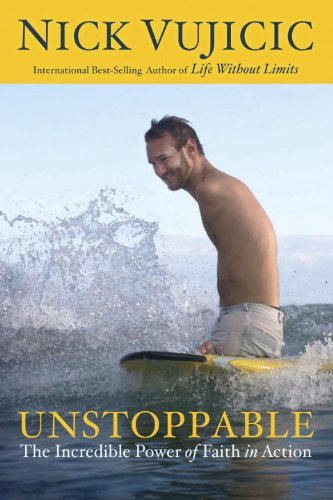
Unstoppable: The Incredible Power of Faith in Action by Nick Vujicic is the story of his faith, the faith of his family, and the faith of people who listen to him give a talk. Nick was born with no limbs. Doctors recommended that his parents euthanize him to prevent suffering, but they believed God allowed things to happen for a reason, even if it was hard to understand at the moment. So, he lived, and grew, and became a man. A man God could use, even without arms and legs, maybe even more so than had he had them.
This is an easy read that kept my interest easily, therefore, I gave it five stars. I received my copy from Blogging for Books in exchange for my honest opinion of the book.
So, it's been 3 years ago today since I walked out of the hospital after contracting bacterial meningitis. How has my life changed since then?
I still am rather isolated. Not many folks visit me and I'm still easily tired by too much social interaction. This is a result of depression and fatigue from the migraines that are the fall out of the meningitis. I'm in pain a lot of days and try not to let others know since that's not really fun to talk about. Instead we talk about dealing with symptoms, daily events, current projects, and so on.
I'm more attuned to the spiritual realm. I see God in others easier than I used to. I also am open to knowing God in different ways than I had previously believed were valid. That is part of my ongoing growth as a Catholic, and part of my growth as a child of God. I have been challenged to pray not just for the victims of various crimes, but also for the perpetrators of crimes too. Even for those doing horrendous things, they are still able to be children of God, they just haven't realized it yet.
I'm about the same physically, though much less interested in being physical. The bright noonday sun is too bright for my eyes, so I wear a baseball cap, but that is not enough to protect my eyes from the photophobia. The lights inside stores are also horrible for my migraines. I do utilize physical therapy exercises in the morning and evenings, but going for a walk is still unusual. Doing more than a walk is unheard of, unless I'm on a vacation where there is a swimming pool.
I knit and crochet and spin now almost daily. These activities were sometimes activities before. Now, I know I'm doing well emotionally when I'm doing regular crafting. Though, when I don't craft, that is a good signal that I'm not feeling well.
So, overall, how am I doing now compared to 3 years ago? I am able to do more for myself than when I immediately had left the hospital. I may have walked out of the hospital, but it wasn't very fast or very far to the car. Now, unless I'm in great pain or feeling sick, I can walk pretty good for both distance and speed. Yet, I'm still not back to where I was pre getting sick. I'm variously frustrated, sad, angry, and accepting of this difference.
What are your ways of knowing you are in a healthy space? How has your life changed in the last few years?